Modern artist rug in Alexandre Calder style, 3 x 2 m, in wool, high quality hand knotted
Inspired by one of the most respected pioneers of contemporary art, the Alexandre Calder Modern Artists' Rug adds a touch of sophistication to any room. Every detail of the intricate design of this hand-knotted wool rug has been carefully considered to evoke Calder's iconic works, all on a luxury 3m x 2m product that is sure to make a bold statement. Thanks to the high-quality wool, this rug is not only aesthetically pleasing, but also remarkably sturdy and designed to withstand everyday wear and tear. Add a functional piece of art to your home with the Alexandre Calder Modern Artists Rug. Alexander “Sandy” Calder is an American sculptor and painter, born July 22, 1898 in Lawnton and died November 11, 1976 in New York. Date/Place of Birth: July 22, 1898, Lawnton, Pennsylvania, United States Date of Death: November 11, 1976, New York, New York State, United States Honors: Presidential Medal of Freedom Periods: Kinetic Art, Modern Art , Surrealism, Puteaux Group Children: Mary Calder Rower, Sandra Calder Davidson Wife: Louisa James (m. 1931–1976)
- SKU: acp-23-mn
- Shipping:
- Return Policy: We understand that buying a rug can be a big investment and we want you to be completely satisfied with your purchase. For this reason, we offer a 30-day return policy for rugs purchased from our site. If you are unhappy with your rug for any reason, you may contact us within 30 days of receiving your order to request a return. Carpet must be in its original, unused, undamaged condition with all tags and accessories included. We reserve the right to refuse a return if the rug is not in its original condition. Return costs are the responsibility of the customer, unless the rug is faulty or we have made an error in your order. If your rug is eligible for a refund, it will be processed within 5 days of receipt of the returned rug. Please note that our 30 day return policy does not apply to personalized or bespoke rugs, which are subject to specific return conditions. We encourage you to read this information carefully before placing your order. If you have any questions regarding our return policy or would like to return a rug, please contact us and we will be happy to assist you.
Learn More
Alexander Calder | 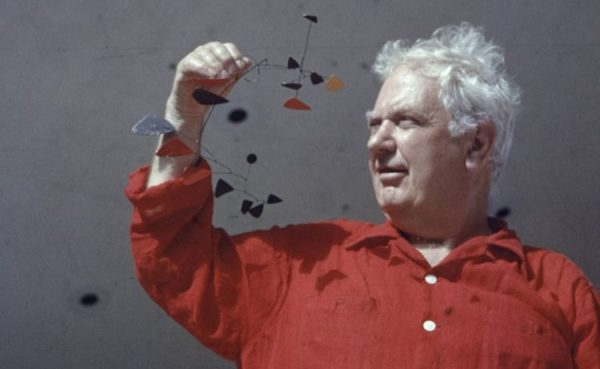 |
Born into an artistic family in Pennsylvania, Alexander Calder was encouraged to create and invent from a very young age. His parents set up a studio for him in the basement of the family home in California, where they had settled. The young boy was already passionate about movement and imagined becoming a mechanical engineer. In 1923, Sandy (as his parents nicknamed him) finally enrolled in an art school in New York. He had the ambition to become an artist. The city's ever-lively theater fascinated him. In 1926, he was in Paris, trying his luck as a painter and illustrator. A meeting with a toymaker of Serbian origin gave him new ideas: he began working with wire, making small animal toys, inspired by the drawings he made as a child in New York zoos. The sculptor was born! From these tinkerings, the artist created a world: it would become his Cirque Calder, with which he acquired a small notoriety. The figurines were animated by the artist, who played Monsieur Loyal. His articulated toys were exhibited at the Salon des Humoristes in 1927. At this time, he created wire portraits of his friends, such as Fernand Léger. He also became friends with the abstract painter Piet Mondrian, whose works he admired. Calder, in turn, decided to launch himself into abstract art... but by putting it into movement! His source of inspiration? The ballet of the stars and the cosmos. He joined the Abstraction-Création group founded by Auguste Herbin, Jean Hélion, and Georges Vantongerloo. It was Marcel Duchamp who, in 1932, found the right term to describe Alexander Calder's suspended sculptures: mobiles! Thanks to wire and an electrical system, balls and abstract shapes inspired by nature came to life. He also created works governed by an opposing principle, immobility. These would be the stabiles, whose base is firmly anchored to the ground. In some cases, the sculptor combined the two, uniting the aerial with the earthly, spontaneous change with immobile solidity. The artist exhibited his works in various prestigious circumstances (Museum of Art in 1943, Venice Biennale in 1952, etc.). The 1930s were fertile. Calder notably received a commission for a fountain (The Mercury Fountain), a symbol of resistance to Francoism, for the 1937 World's Fair held in Paris. Precisely, faced with the rise of fascism in Europe, he and his wife returned to the United States and settled in the countryside. There, friends who had fled France met: Marcel Duchamp, Fernand Léger, etc. Returning to France, he settled in 1953 in Saché, in the Tours region, and built a house, open to friends. He also partnered with a local factory, which supplied him with sheet metal and enabled him to create large-scale works for public spaces. Since 1989, thirteen years after the sculptor's death, the Calder Foundation in New York has become an artist residency. | |