Jean Michel Basquiat Notary modern contemporary rug
Jean-Michel Basquiat 1978-1988 (after) Notary Modern contemporary rug after Jean-Michel BASQUIAT Very good overall condition. Hand-made and hand-knotted rug. Wool pile on cotton foundation. Remarkable suppleness and silky wool quality, beautiful polychromy. Dimensions: 3 x 2 m Notary is a triptych created by the American painter Jean-Michel Basquiat in 1983. Mounted on wooden frames, the canvases that compose it were executed in acrylic paint or grease pencil and decorated with glued papers. Around two central figures evoking a human skull and a flayed person appear numerous inscriptions in English, among which "notary", which means "notary". The work is part of the private collection of the Schorr family and is on loan to the Princeton University Art Museum in New Jersey. The Jean-Michel Basquiat contemporary rug is an exceptional piece of art that pays homage to the world-renowned artist. Its modern style and vibrant color palette are perfect for adding an artistic touch to any decor. A work of art to have within your reach. Jean-Michel Basquiat, born December 22, 1960 in Brooklyn and died August 12, 1988 in NoHo, was an American painter. He became a popular avant-garde painter and pioneer of the underground movement at an early age. Date/Place of Birth: December 22, 1960, Brooklyn, New York, New York, United States Date of Death: August 12, 1988, Great Jones Street, New York, New York, United States Periods: Contemporary Art, Neo-Expressionism, Primitivism Venue: UCCA Center for Contemporary Art Influences: Andy Warhol, Pablo Picasso, Cy Twombly, Robert Rauschenberg, Jean Dubuffet Parents: Matilda Andrades, Gerard Basquiat Siblings: Jeanine Basquiat, Lisane Basquiat, Max Basquiat
- SKU: jmbn-23-mn
- Shipping:
- Return Policy: We understand that buying a rug can be a big investment and we want you to be completely satisfied with your purchase. For this reason, we offer a 30-day return policy for rugs purchased from our site. If you are unhappy with your rug for any reason, you may contact us within 30 days of receiving your order to request a return. Carpet must be in its original, unused, undamaged condition with all tags and accessories included. We reserve the right to refuse a return if the rug is not in its original condition. Return costs are the responsibility of the customer, unless the rug is faulty or we have made an error in your order. If your rug is eligible for a refund, it will be processed within 5 days of receipt of the returned rug. Please note that our 30 day return policy does not apply to personalized or bespoke rugs, which are subject to specific return conditions. We encourage you to read this information carefully before placing your order. If you have any questions regarding our return policy or would like to return a rug, please contact us and we will be happy to assist you.
Learn More
Jean-Michel Basquiat | 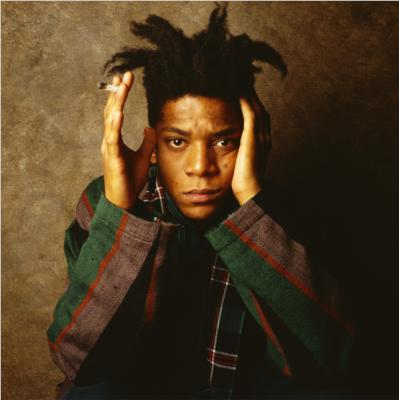 |
Jean-Michel Basquiat was born in New York City's Park Slope neighborhood of Brooklyn on December 22, 1960. His mother, Matilde, was a New Yorker of Puerto Rican descent, and his father, Gérard, from a prominent Haitian family who fled the Duvalier dictatorship, was a chartered accountant in New York City. Jean-Michel had two younger sisters: Lisane, born in 1964, and Jeanine, born in 1967. A precocious child, he learned to read and write at the age of four and was fluent in three languages by the age of eight: English, French, and Spanish. His mother, who was interested in art, regularly took the young Jean-Michel to the Museum of Modern Art and encouraged him to develop his drawing skills. In September 1968—he was seven years old—Jean-Michel was hit by a car while playing in the street with his friends. His arm was injured and he also suffered internal injuries that required the removal of his spleen. While he was recovering in hospital, his mother gave him a medical anatomy treatise entitled Henry Gray's Anatomy of the Human Body (or more commonly Gray's Anatomy). Like Leonardo da Vinci's anatomical plates, this work would strongly influence the artist in the early part of his work; he would also later draw inspiration from it to name his music group Gray. Suffering from mental illness, his mother regularly spent time in specialized institutions. Her health deteriorated, and family life became difficult. His parents separated in 1968, and custody of the children was entrusted to his father. Thus, he and his two younger sisters went to live with their father for five years, before the family moved to Puerto Rico in 1974. After two years in San Juan, they returned to New York. Basquiat was then 15 years old. He was subsequently sent to the private Saint Ann's School in Brooklyn, an upscale institution whose arts-oriented curriculum emphasized practical learning. There, he met Al Diaz, a graffiti artist with whom he would form a close friendship. In December 1976, he ran away to Greenwich Village, wandering around Washington Square Park for a week, sleeping and eating wherever he could, before being arrested and brought back to his father. He dropped out of high school before completing his studies, left his father's house, from which he was permanently banished, and moved in with friends. He supported himself by selling T-shirts and postcards he made on the street and by working in a clothing store. | |